10 Essential Tips for The Grammar Index Success in 2026
Why do we spend hours memorizing the difference between the present perfect and the past simple only to forget the rules the moment we close our textbooks? It's a common frustration shared by millions of learners who feel buried under a mountain of over 300 grammar topics. You likely feel that the more you study, the more the details slip away. Finding the right tips for The Grammar Index success is the first step toward ending this cycle of frustration and replacing confusion with organized progress.
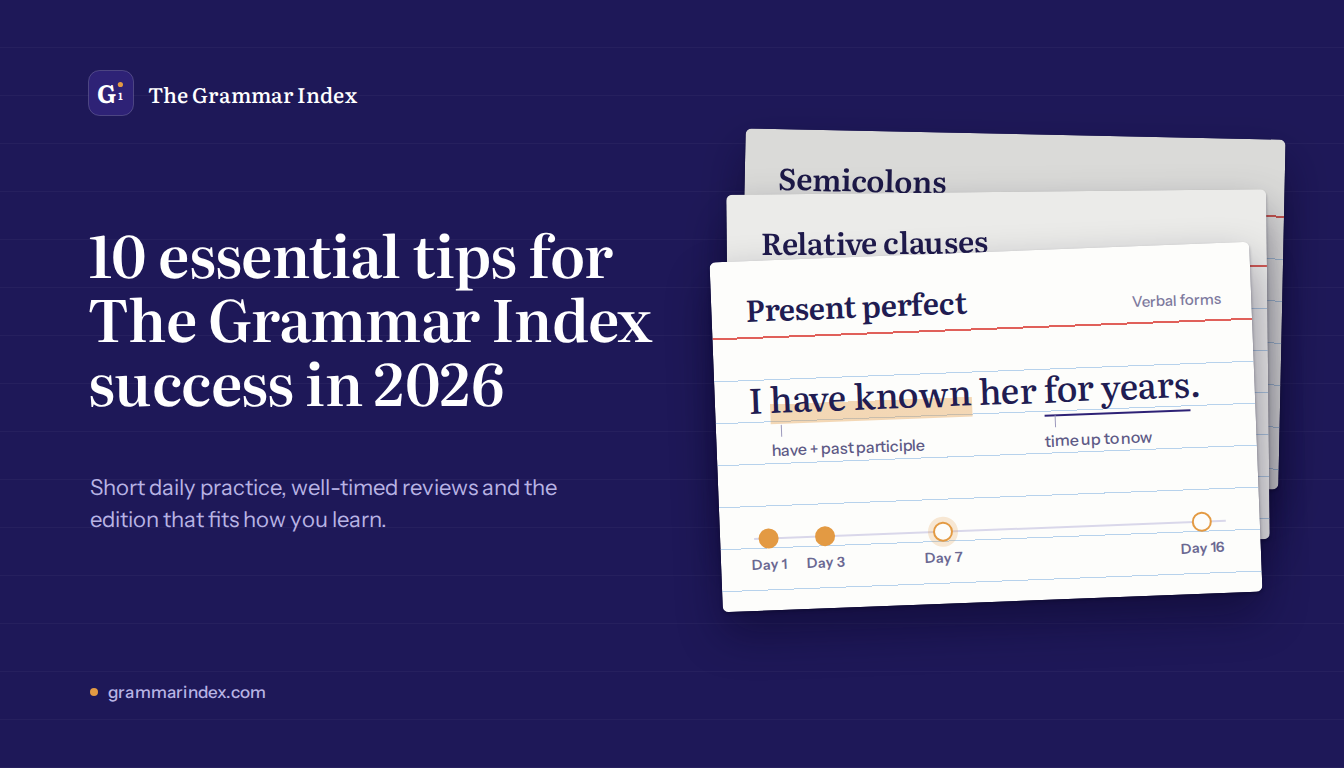
10 Essential Tips for The Grammar Index Success in 2026
Why do we spend hours memorizing the difference between the present perfect and the past simple only to forget the rules the moment we close our textbooks? It's a common frustration shared by millions of learners who feel buried under a mountain of over 300 grammar topics. You likely feel that the more you study, the more the details slip away. Finding the right tips for The Grammar Index success is the first step toward ending this cycle of frustration and replacing confusion with organized progress.
This guide will show you how to master the art of English grammar by leveraging unique spaced-repetition drills and curriculum-aligned resources. Whether you're using The Grammar Index Multilingual Edition to bridge the gap from your native language or the Key Stage 2 & 3 Edition for school alignment, permanent retention is finally within reach. We'll explore how to integrate these tools into your daily routine, use native-language scaffolding to bridge linguistic gaps, and ensure these grammar rules translate into polished, professional writing. By following a methodical approach, you can transform your academic or professional communication into a model of clarity and accuracy.
Key Takeaways
- You'll see better results by shifting from passive reading to active daily habits.
- Leverage spaced-repetition drills to target specific linguistic weaknesses, ensuring permanent retention through scientifically scheduled reviews.
- Selecting the version that fits your specific goals, like the Key Stage 2 & 3 Edition for school alignment, is one of the most vital tips for The Grammar Index success.
- Combine daily ten-minute quizzes with auditory reinforcement to internalize the natural rhythm and syntax of correct English sentences.
- Scale institutional achievement by integrating the platform's comprehensive resources directly into digital ecosystems like Google Classroom and Microsoft Teams.
Table of Contents
- Understanding the Framework for The Grammar Index Success
- Strategic Tip: Utilizing Spaced Repetition for Permanent Mastery
- Navigating the Three Editions for Targeted Academic Success
- Practical Habits: Daily Drills, Quizzes, and Auditory Reinforcement
- Institutional Excellence: Scaling Success in Modern Classrooms
Understanding the Framework for The Grammar Index Success
Success in language acquisition isn't about having a digital dictionary on your phone; it's about how you interact with the material. Many students treat grammar tools as a reference they only check when they're stuck. Real progress happens when you shift to an active-learning habit. This is one of the most foundational tips for The Grammar Index success. Instead of viewing the platform as a static digital textbook, think of it as a methodical mentor that guides you through a planned curriculum. A methodical mentor doesn't just provide answers; it organizes the vast landscape of English grammar into a sequence that makes sense. For 2026, your goal should be to integrate these tools into your daily digital ecosystem. This means moving away from infrequent cramming sessions and toward consistent, small interactions. When you treat the platform as a daily partner in your education, the complexity of 300+ topics begins to dissolve into a series of achievable wins.
Demystifying the 300+ Topic Index
Facing over 300 grammar topics can feel overwhelming for any learner. The Grammar Index organizes these rules into a logical hierarchy to prevent information overload. You don't need to master everything at once. Focus first on high-impact areas like verb tenses and sentence syntax, as these form the backbone of clear communication. The Index serves as a structured path to fluency by categorizing complex linguistic rules into manageable, logical levels. By identifying your current proficiency level within this framework, you can set realistic milestones for 2026 that prioritize steady, sustainable growth. This assessment ensures you aren't wasting time on concepts you've already mastered while ignoring the gaps that hinder your professional or academic writing.
Moving Beyond Passive Reading
Reading a definition is only about 10% of the learning process. You might understand a rule intellectually, but that doesn't mean you can use it during a fast-paced meeting or in a timed essay. Success requires a transition from understanding to application. This is where you move from reading definitions to completing targeted quizzes and reviewing worked examples. These examples build visual recognition of correct grammar, helping you spot errors before they're finalized. This approach utilizes an evidence-based learning technique to ensure that once you learn a rule, it stays in your long-term memory. It's a systematic way to bridge the gap between knowing a rule and naturally speaking it. By applying these tips for The Grammar Index success, you turn passive information into a permanent skill set.
Strategic Tip: Utilizing Spaced Repetition for Permanent Mastery
Many learners believe that simply seeing a correction once is enough to prevent future errors. However, true linguistic mastery requires more than a single moment of clarity. One of the most effective tips for The Grammar Index success involves mastering the platform's spaced-repetition drills. This pedagogical science is based on the idea that our brains need to encounter information at specific intervals to move it from short-term memory into permanent storage. Instead of showing you every rule at the same frequency, the platform's algorithm acts as a diagnostic mentor. It identifies your "weak" rules based on your performance in quizzes and drills, then schedules those specific topics for review exactly when your memory is most likely to fade. This targeted approach ensures you aren't wasting time on concepts you already know, allowing you to focus your energy where it's needed most.
Active recall is the engine that drives this process. While section one discussed the pitfalls of passive reading, spaced repetition takes active learning a step further by forcing your brain to retrieve a rule from memory without help. This mental effort strengthens neural pathways far more effectively than reading a definition ten times. For professionals who need high writing accuracy, this means rules like subject-verb agreement or complex tense usage become second nature. You won't have to stop and think about the rule; your brain will simply recognize the correct syntax. To get started, you can explore the drill settings in The Grammar Index Original Edition to tailor the intensity to your current goals.
How Spaced Repetition Drills Work
The mechanics of a drill follow a logical path from initial exposure to total mastery. When you first encounter a topic among the 300+ available, the app tracks your response time and accuracy. If you struggle with a specific drill, the algorithm increases the frequency of that topic in your daily queue. As your accuracy improves, the intervals between reviews grow longer. This data-driven feedback allows you to track your progress over time through clear visual metrics. You can optimize your drill settings to increase the cognitive load, which challenges your brain without leading to burnout. This balance is key to maintaining a steady, structured progression through the curriculum.
Beating the Forgetting Curve
The science of memory shows that we often forget up to 80% of new information within just 48 hours if it isn't reinforced. This is known as the forgetting curve, and it's the primary reason why a two-hour weekly cramming session is less effective than a five-minute daily drill. By interacting with the app every day, you intercept the forgetting process at its most critical point. Consistency is the primary driver of retention. A methodical approach to daily practice ensures that grammar rules aren't just temporary facts but permanent skills that stay with you for life.
Navigating the Three Editions for Targeted Academic Success
Success in English mastery isn't a one-size-fits-all journey; it requires a tool tailored to your specific linguistic background and educational level. One of the most practical tips for The Grammar Index success is selecting the edition that best matches your current environment. Understanding which edition fits your profile is one of the essential tips for The Grammar Index success in a globalized academic environment. The platform offers three distinct versions, each designed to meet unique pedagogical needs. For non-native speakers, The Grammar Index Multilingual Edition provides essential support in 34 different languages, allowing for a smoother transition into complex English syntax. Younger learners benefit from the Key Stage 2 & 3 Edition, which is precisely aligned with the UK National Curriculum to support primary and early secondary education. Meanwhile, The Grammar Index Original Edition serves as the definitive reference for advanced students and native speakers who want to polish their professional communication to a high standard. By choosing the correct edition, you ensure that the methodical mentor persona of the app is working at its most effective level for your specific goals.
The Power of Multilingual Scaffolding
Understanding a new language is significantly faster when you can relate new rules to your existing knowledge. Modern multilingual English learning tools accelerate this process by providing explanations in your native tongue. This scaffolding helps demystify complex concepts like modal verbs or definite articles, which can be notoriously difficult to translate without a point of reference. By switching between languages, you can test your true conceptual understanding rather than just memorizing a pattern. It's a method that replaces confusion with a sense of organized progress across 34 different linguistic frameworks, making high-level learning available across cultures.
Winning the KS2/KS3 SPAG Requirements
For students in the UK, the Spelling, Punctuation, and Grammar (SPAG) requirements are a critical part of academic assessment. The Key Stage 2 & 3 Edition targets the specific rules required for SATs and secondary school transitions. It functions as a comprehensive digital workbook, offering drills on advanced syntax and punctuation that are often overlooked in general courses. Students can use the app to practice the rhythm of correct syntax, ensuring they meet the high standards expected by educational institutions. By mastering these topics early, learners build a strong foundation that supports their writing across all subjects. This targeted preparation ensures they're ready for the increased academic rigor of secondary education, turning a potentially intimidating process into a series of manageable steps.

Practical Habits: Daily Drills, Quizzes, and Auditory Reinforcement
Building a successful learning routine is about creating a sequence of small, manageable actions that lead to long-term mastery. To implement the best tips for The Grammar Index success, you should follow a structured four-step daily habit. First, begin your morning with a 10-minute quiz on a new topic from the index. This active start primes your brain for learning. Second, utilize the professional audio features to hear the rhythm of correct syntax. Third, complete your scheduled spaced-repetition drills to reinforce the rules you've studied previously, as we discussed in our strategy for permanent mastery. Finally, apply the new rule immediately by writing a short exercise, such as a three-sentence professional email or a journal entry. This methodical approach ensures that grammar rules aren't just abstract concepts but functional tools you can use with confidence.
The Role of Audio in Grammar Intuition
Many learners rely solely on text-based examples, which can lead to a stiff and unnatural writing style. Hearing grammar is just as vital as reading it, especially for non-native speakers who need to understand the cadence of English. By using audio drills, you can master word stress and sentence intonation, which are essential for clear communication. This auditory reinforcement helps you build an "ear" for correct grammar. Over time, you'll start to hear when a sentence sounds wrong, allowing you to catch errors in your own speech and writing before they become habits. This is a critical step in moving from academic understanding to natural fluency. To experience this first-hand, you can explore the auditory features in The Grammar Index Multilingual Edition today.
Leveraging Quizzes for Self-Assessment
Self-assessment is the bridge between thinking you know a rule and proving you can use it. Quizzes provide the data-driven feedback necessary to track your progress accurately. Instead of guessing your proficiency, you can analyze your quiz mistakes to identify recurring patterns of error. This allows you to target your study time more effectively. A successful habit involves retaking these quizzes until you consistently achieve a 100% mastery score. This level of rigor ensures that your understanding is complete and that you are ready to move on to more complex topics. By integrating these tips for The Grammar Index success into your daily routine, you replace confusion with organized progress, making the learning process less intimidating and more rewarding.
Institutional Excellence: Scaling Success in Modern Classrooms
Schools face the constant challenge of maintaining consistent standards across diverse student populations. Deploying the platform at a department-wide level is one of the most effective tips for The Grammar Index success in modern educational settings. By providing every student with a personalized grammar mentor, institutions can ensure that a learner isn't left behind due to a lack of individual attention. The platform's teacher-facing data dashboards allow educators to monitor progress in real-time, identifying specific gaps in a cohort's understanding before they impact exam results. This methodical approach transforms the study of 300+ topics from a chaotic task into a structured, data-driven curriculum. It empowers teachers to act as master educators who use technology to make linguistic mastery available to everyone in the classroom.
Integrating with Google Classroom and Teams
Educators can assign specific grammar topics as homework directly through their existing educational suites. This integration streamlines the assessment process by syncing grades and progress reports automatically. It significantly reduces teacher workload by automating the marking of repetitive grammar drills, allowing staff to focus on more complex creative writing and analytical tasks. This creates a seamless digital ecosystem where students can move between their main curriculum and targeted grammar practice without friction. The transition between different sections is smooth and purposeful, ensuring that the student feels led through a comprehensive learning journey rather than just a collection of random features.
The Future of Digital Grammar Textbooks
Digital editions are rapidly replacing physical reference books in UK schools. They offer a level of interactivity and accessibility that traditional textbooks simply can't match. For instance, ensuring every student has access to multilingual support at home and in class is a major advantage for schools with a high percentage of non-native speakers. Institutional Licensing represents a strategic investment for high-performing schools looking to modernize their linguistic frameworks. By adopting the Key Stage 2 & 3 Edition or the Multilingual Edition at scale, schools provide a definitive and reliable resource that supports linguistic mastery across all year groups. This global and inclusive approach breaks down barriers, making high-level learning available across different platforms and cultures within the school community.
Master Your Linguistic Future in 2026
Achieving mastery over the English language requires more than just a reference tool; it demands a systematic approach to learning. By moving from passive reading to active, data-driven drills, you ensure that complex rules become permanent skills. Whether you're utilizing the Multilingual Edition to bridge linguistic gaps or the Key Stage 2 & 3 Edition to meet UK National Curriculum standards, the right framework makes all the difference. By embracing these strategies, you replace confusion with organized progress, turning a vast curriculum into a series of manageable victories.
Implementing these Tips for The Grammar Index success will help you navigate over 300 comprehensive topics with confidence and clarity. With support for 34 languages and a methodical mentor by your side, your path to fluency is clearer than ever. Start your journey to English mastery with The Grammar Index today. You've got the tools to succeed; now it's time to build the habit.
Frequently Asked Questions
How often should I use The Grammar Index for the best results?
Consistency is the primary driver of retention for any learner. You'll achieve the best results by engaging with the app for 10 to 15 minutes every day rather than cramming for several hours once a week. This daily habit allows the spaced-repetition algorithm to intercept the forgetting curve at the most effective intervals. Following these tips for The Grammar Index success ensures that the 300+ topics move from short-term memory into permanent linguistic mastery.
Can I use the Multilingual Edition if I'm a beginner in English?
Yes, The Grammar Index Multilingual Edition is specifically designed for learners at all levels, including absolute beginners. It provides support in 34 different languages, allowing you to use your native tongue as a scaffold for understanding complex English rules. This feature demystifies difficult concepts like articles or modal verbs by providing clear explanations in a language you already know. It's a welcoming space that replaces initial confusion with a sense of organized progress.
Does the Key Stage 2 & 3 Edition cover the whole UK National Curriculum?
The Key Stage 2 & 3 Edition is precisely aligned with the UK National Curriculum requirements for spelling, punctuation, and grammar. It functions as a definitive digital tool for students aged 7 to 13 who are preparing for SATs or secondary school transitions. The content covers the specific syntax and punctuation rules mandated by educational standards. This ensures that young learners build a strong foundation that supports their academic writing across all subjects in the UK school system.
Is there an offline mode for the mobile app?
The Grammar Index is available across multiple platforms, including iOS, Android, Windows, and the Web. While the app is designed for seamless integration with modern digital ecosystems, users should check their specific device settings for current offline capabilities. The platform prioritizes accessibility, ensuring that learners can engage with drills and quizzes across different environments. This flexibility allows you to maintain your daily learning rhythm whether you are at home, in school, or on the move.
How does the app integrate with Google Classroom for teachers?
The platform integrates directly with Google Classroom and Microsoft Teams for Education to streamline classroom management. Teachers can assign specific grammar topics or drills as homework and sync student progress reports automatically for assessment. This automation reduces the manual workload of marking repetitive exercises, allowing educators to focus on more complex instruction. It creates a methodical ecosystem where institutional success is monitored through clear, data-driven dashboards that track every student's individual journey.
What is the difference between the Original and Multilingual editions?
The Grammar Index Original Edition serves as a definitive reference for advanced students and native speakers who want to polish their professional syntax. In contrast, The Grammar Index Multilingual Edition is tailored for global learners, providing comprehensive support in 34 languages. While both versions feature the same 300+ topics and spaced-repetition drills, the Multilingual version uses native-language scaffolding to help non-native speakers demystify complex English concepts more effectively. Both editions provide a reliable path to linguistic mastery.
Can institutions track individual student progress through the app?
Institutions can monitor individual student progress through the app's dedicated teacher-facing data dashboards. This feature allows schools to identify specific areas where a cohort or a single student might be struggling with the 300+ grammar topics. By analyzing this real-time data, educators can provide targeted support to ensure no learner is left behind. These insights are essential tips for The Grammar Index success when scaling the platform across a whole department or school district.
Does the app help with professional writing or just basic grammar?
The app is a comprehensive tool that supports both basic grammar and advanced professional writing. With over 300 topics, it covers complex sentence syntax, nuances of verb tenses, and formal punctuation rules required in academic or corporate settings. Features like auditory reinforcement and worked examples help you internalize the rhythm of professional English. This methodical approach ensures that your writing is accurate, clear, and authoritative, which is vital for success in any high-level professional environment.